In short: A full hookup site gives your RV water, electric, and sewer at the site. A partial hookup site usually has water and electric, so you empty your tanks at a dump station. Dry camping means a developed campground site with no hookups, and boondocking means camping outside a campground, usually on public land, with nothing provided at all. Match the site to your RV's power needs, tank sizes, and how self-sufficient you want to be, then filter by hookups on OutReserve.
You find a campground in the right place, the dates are open, and the listing offers three or four kinds of RV sites at different prices. The difference comes down to what is waiting at the pad: a water spigot, a power pedestal, a sewer connection, all three, or nothing. The wrong pick can mean a dead battery by night two or paying for hookups you never use.
What a hookup actually is
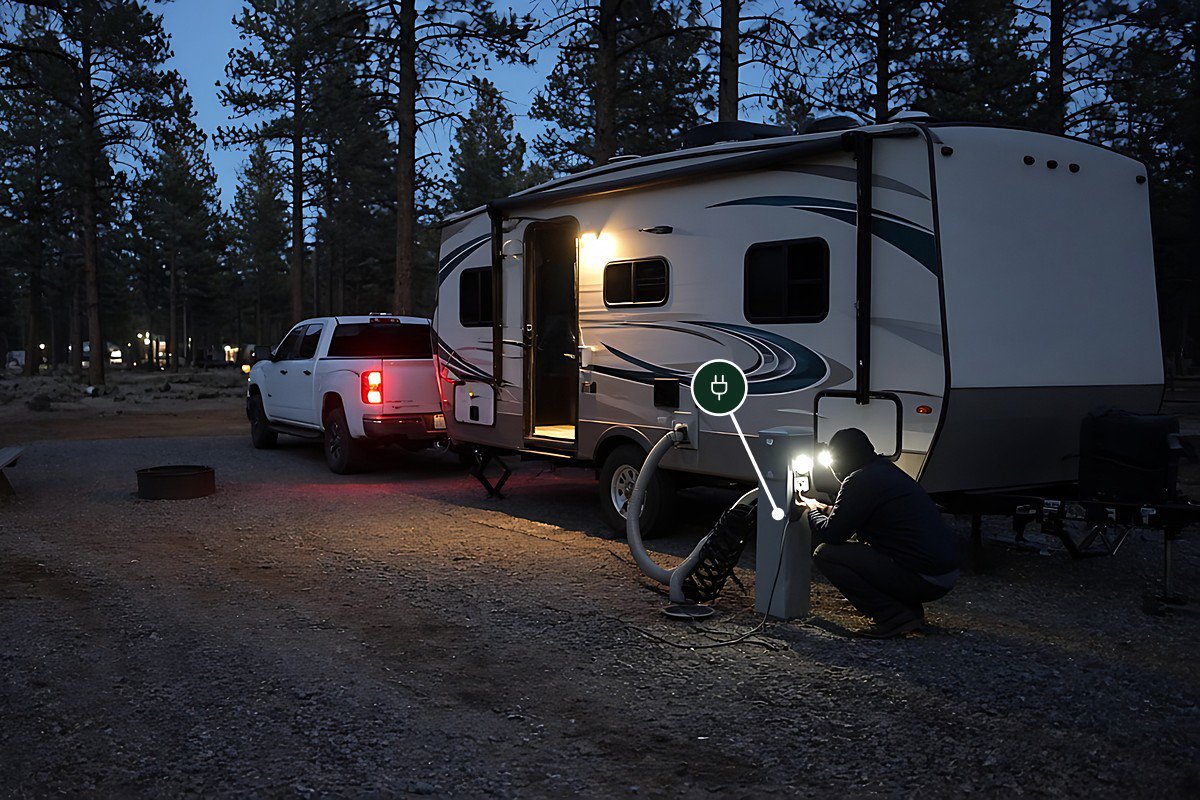
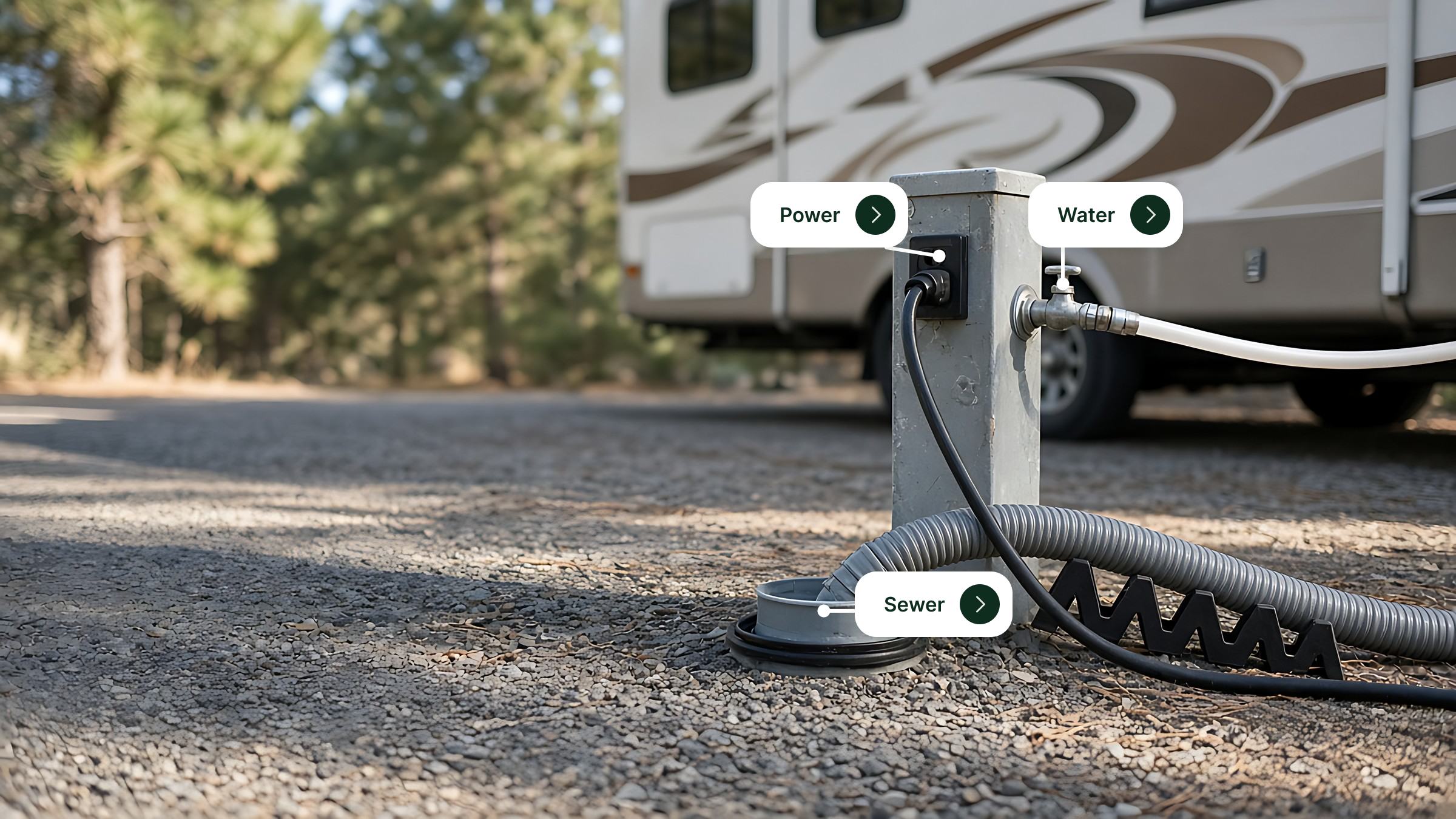
A hookup is a utility connection at your site. Water is a spigot for your drinking water hose, electric is a power pedestal for your RV's shore power cord, and sewer is a drain connection where your sewer hose empties your black and gray tanks.
Electric service is usually listed by amps:
- 30 amp service delivers up to about 3,600 watts, enough for one air conditioner if you watch what else is running
- 50 amp service delivers up to about 12,000 watts and is common on larger RVs with two air conditioners. You can plug a 50 amp RV into a 30 amp pedestal with an adapter, but you only get 30 amp power, so check your RV's plug before you pick a site.
Full hookup sites
A full hookup site has water, electric, and sewer at the pad. You connect once and live much like at home, with no counting gallons and no dump station stop on the way out. Some full hookup sites also include cable TV or Wi-Fi.
What are full hookup sites good for? Full hookups suit longer stays, larger groups, hot or cold weather, and anyone who would rather not manage tank levels. They are usually the most expensive RV sites at a property, and many campgrounds have fewer of them than other site types, so they can go first on busy weekends.
Partial hookup and electric-only sites
A partial hookup site usually means water and electric without sewer. You run on shore power and campground water, and your gray and black tanks fill as you go. When you leave, or partway through a longer stay, you empty them at the campground's dump station.
What are partial hookup sites good for? Partial hookups work well for weekend trips, smaller RVs, and travelers whose tanks comfortably cover the stay. Labels vary by campground, though. Some use "partial" for electric-only sites, and some use other terms for sites that have power but no water, so read the listing for which of the three connections the site actually has.
Dry camping at a campground
Dry camping means a site inside a developed campground with no hookups at all. You still get a defined site, and often a picnic table, fire ring, restrooms, a central water spigot, and a dump station on the property, but your RV runs on its own batteries, solar or generator, and tanks.
Many national park campgrounds work this way. YosemiteX, for example, has no hookups and sends RV wastewater to designated dump stations. Dry camping is a good fit for tent campers, smaller self-contained RVs, and anyone who wants a scenic, reserved site in a public park. If you plan to run a generator, check the campground's generator hours first, because many parks limit them to set windows, such as morning, midday, and early evening at Joshua Tree.
Boondocking and dispersed camping
Boondocking means camping outside a developed campground, usually on public land managed by the Bureau of Land Management or the US Forest Service. The agencies call it dispersed camping. There are no hookups, and as the Forest Service puts it, no services such as piped water, toilets, or trash removal, so you bring everything in and pack everything out.
In return, dispersed camping is usually free and needs no reservation. The BLM says most of its lands allow it unless an area is posted closed, with a stay limit that is generally 14 days within any 28-day period before you move to a new spot. National forests set their own limits, often around 14 days. Both agencies ask campers to use existing sites, stay on designated roads, keep a distance from water, and check current fire restrictions, which lines up with the Leave No Trace principles.
Boondocking suits experienced, fully self-contained campers who want space and quiet more than amenities. Because it happens outside campgrounds, you cannot book it on OutReserve or anywhere else. Many boondockers still book a developed site every so often to dump tanks, refill water, and recharge.
Site types at a glance
- Full hookup: What you get at the site: Water, electric (30 or 50 amp), sewer; sometimes cable or Wi-Fi. Who it suits: Long stays, larger RVs, hot or cold weather. What to bring or plan: Sewer hose, water hose, pressure regulator, surge protector. Typical price direction: Highest of the RV sites.
- Partial hookup: What you get at the site: Usually water and electric, no sewer. Who it suits: Weekend trips, smaller RVs. What to bring or plan: Room in your tanks, a dump station stop. Typical price direction: Usually below full hookup.
- Electric only: What you get at the site: Power, no water or sewer at the site. Who it suits: Short stays, campers who need power. What to bring or plan: Full fresh water tank, dump station plan. Typical price direction: Usually below partial.
- Dry camping: What you get at the site: A developed site, no hookups; shared restrooms or water may be nearby. Who it suits: Tents, self-contained RVs, national and state parks. What to bring or plan: Batteries, solar or generator, full fresh tank. Typical price direction: Usually the lowest at a campground.
- Boondocking: What you get at the site: Nothing provided, outside campgrounds on public land. Who it suits: Experienced, fully self-contained campers. What to bring or plan: Water, power, waste plan, pack out all trash. Typical price direction: Usually free, not reservable.
Pull-through, back-in, and other site layouts
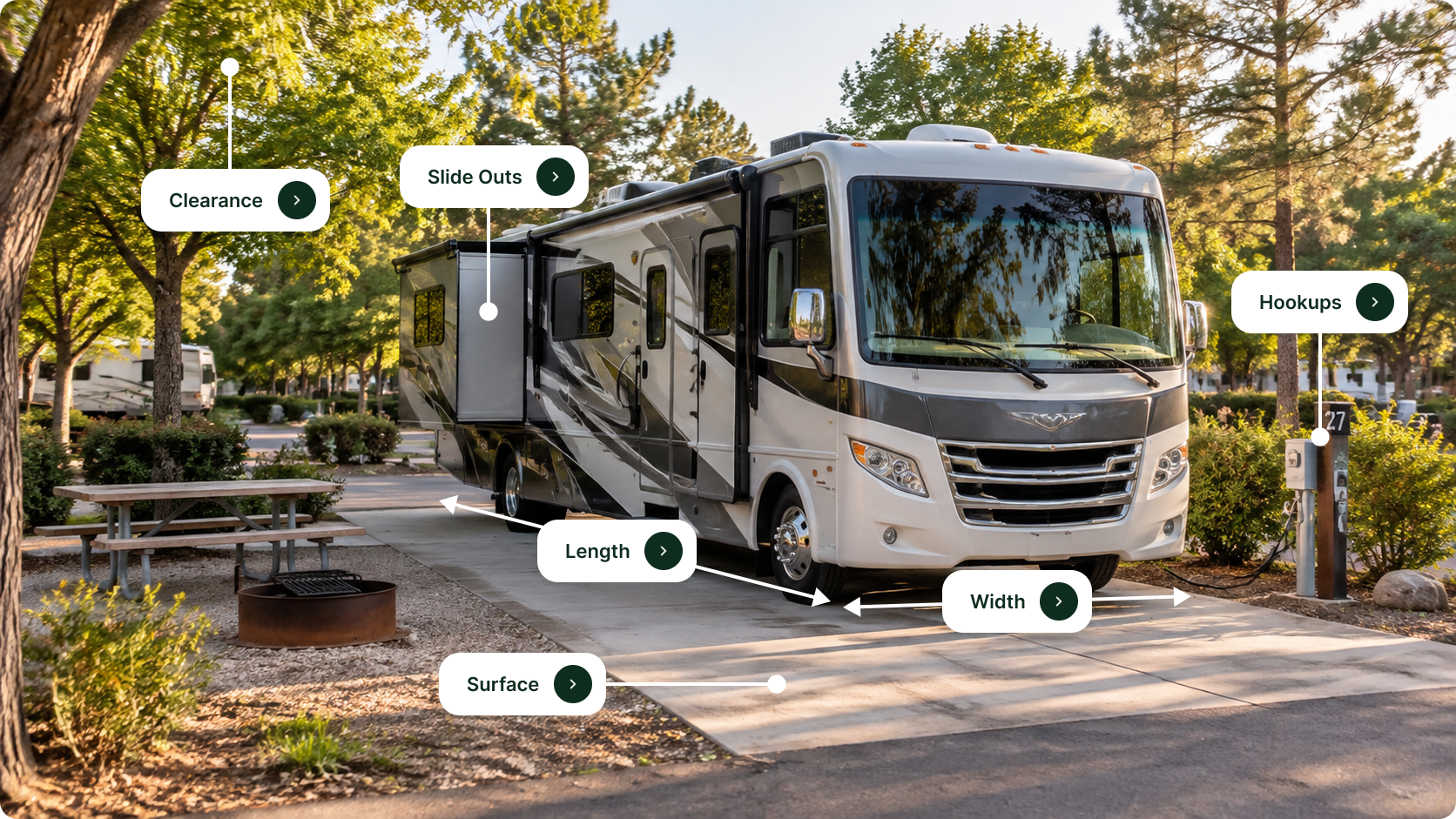
Layout matters as much as hookups. A pull-through site lets you drive in one end and out the other without reversing, which is easier with a long RV or a trailer and handy for one-night stops. A back-in site means reversing onto the pad, which takes more room and practice but often gives you more privacy. Our guide to how to know your RV will fit covers site length, surface, and slide-out clearance in more detail.
Not every site is for an RV. Tent sites usually have a flat pad and may share water and restrooms nearby. Walk-in tent sites add a short walk from the parking spot, which often means more quiet. Cabins and glamping units skip the gear question entirely and book as their own inventory, so a property with no open RV sites may still have a cabin for your dates.
What to check before you book
- Amps: the site's 30 or 50 amp service matches your RV's plug, or you carry the right adapter and accept the lower power.
- Site length and layout: the pad fits your RV plus any tow vehicle, and you know whether it is pull-through or back-in.
- Sewer connection: on full hookup sites, your sewer hose is long enough to reach the connection from your RV's tank outlet.
- Water: a pressure regulator on your hose, since KOA notes water pressure can vary by campground, plus a surge protector for the power pedestal.
- Dump station: on partial, electric-only, or dry sites, the listing shows a dump station.
- Generator rules and quiet hours: if you will run a generator on a dry site.
- Stay limits: for boondocking, the local BLM or Forest Service rules for the area.
How OutReserve helps
On OutReserve, the booking platform for the outdoors, you can search campgrounds and RV parks by destination and dates, then narrow the results with the Site Hookups and Amenities filters: Full Hookups, Water Hookup, Sewer Hookup, 30 Amp Service, 50 Amp Service, Pull-through Site, and Back-in Site. The campground amenity filters include Dump Station, Potable Water, Restrooms, and Showers, which helps when you plan to dry camp. If the site type you want is full for your dates, our guide on what to do when the campground you want is sold out covers your options, including availability alerts.
FAQ
Is a partial hookup enough for a weekend? For many RVs, yes. If your tanks hold a weekend of use for your group, water and electric plus one dump station stop is usually enough.
Can I plug a 50 amp RV into a 30 amp site? Yes, with an adapter, but you are limited to 30 amp power, so you may not be able to run two air conditioners at once.
Is dry camping the same as boondocking? Not quite. Dry camping happens at a developed campground site without hookups. Boondocking happens outside campgrounds, usually on public land, with no facilities at all.
Is boondocking free? Dispersed camping on BLM and national forest land is usually free and needs no reservation, but stay limits and local closures apply, and some busy areas require a permit.
Ready to compare? Search campgrounds and RV parks on OutReserve and filter by full hookups, 30 or 50 amp service, and pull-through sites for your dates.
The right site is the one that matches how you camp. Know what your RV needs, decide how much you want to manage yourself, and spend the trip outside instead of watching tank levels.

Martijn Scheijbeler
Founder & CEO OutReserve